
It was just after four in the morning when the silence of a quiet senior care home in Mesa, Arizona, was broken by the sound that changes everything — one gunshot, then another. Within minutes, what was once a room for two longtime lovers became the site of a tragedy that now has an entire community asking one impossible question: how does love this long end like that?
The victims, 93-year-old Katharine Woolums and her 92-year-old husband Jerome, were not just another elderly couple in the twilight of their lives. They were, by all accounts, inseparable — the kind of couple neighbors described as “sweet,” “gentle,” “old-fashioned.” The kind that still held hands during morning walks. And yet, on that quiet October morning, police say Jerome took a gun and shot his wife in the head before turning it on himself.
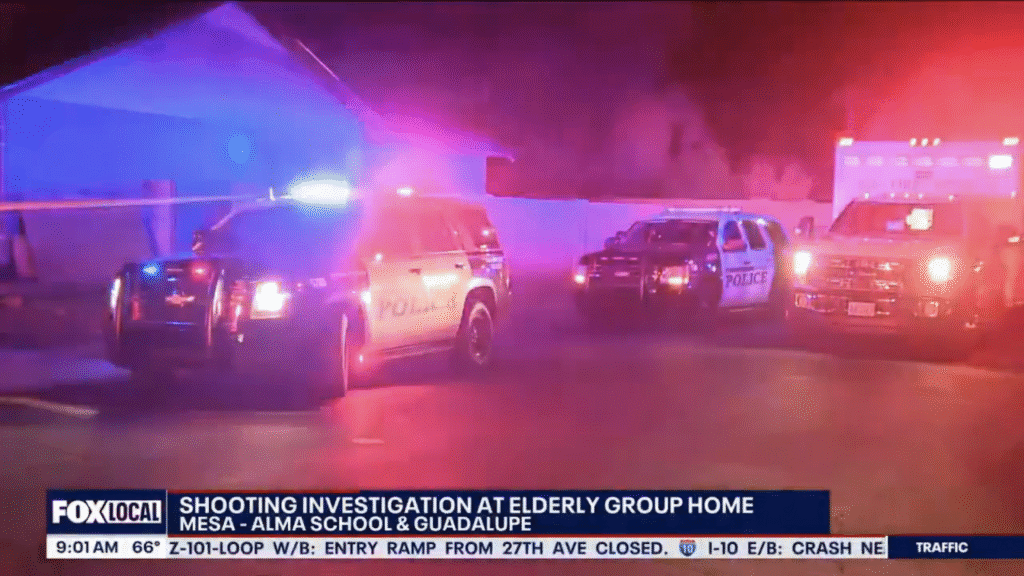
Murder-suicide. Two words that always come with a chill. But when the couple involved are in their nineties — frail, vulnerable, and at the edge of life’s final chapter — that chill turns into something else: confusion, disbelief, even fear.
The call came in just before dawn. Staff at the care home — a small, private residence in Mesa near Alma School Road — found both Jerome and Katharine unresponsive in their shared room. Paramedics rushed to the scene. Jerome was already gone. Katharine still had a faint pulse, and they tried everything. But she died soon after at the hospital.
The gun was found in Jerome’s hand.
Police didn’t take long to reach a conclusion: it appeared to be a murder-suicide. There was no sign of struggle, no evidence of a break-in, and no one else in the room. It was, by all accounts, an act carried out by one elderly man against the woman he had shared a lifetime with.
And that’s what makes it almost unbearable to process.
Because the question isn’t just what happened, but why.
Why would a 92-year-old man — in the final stretch of a long marriage, with days measured in doctor visits and medication schedules — decide to take not only his own life but that of the woman he’d spent decades loving? Was it mercy? Was it madness? Was it fear of the inevitable?
No note was found. No witnesses heard an argument. Police say they’re investigating, but at this stage, the story seems simple — and yet, in its simplicity, deeply haunting.
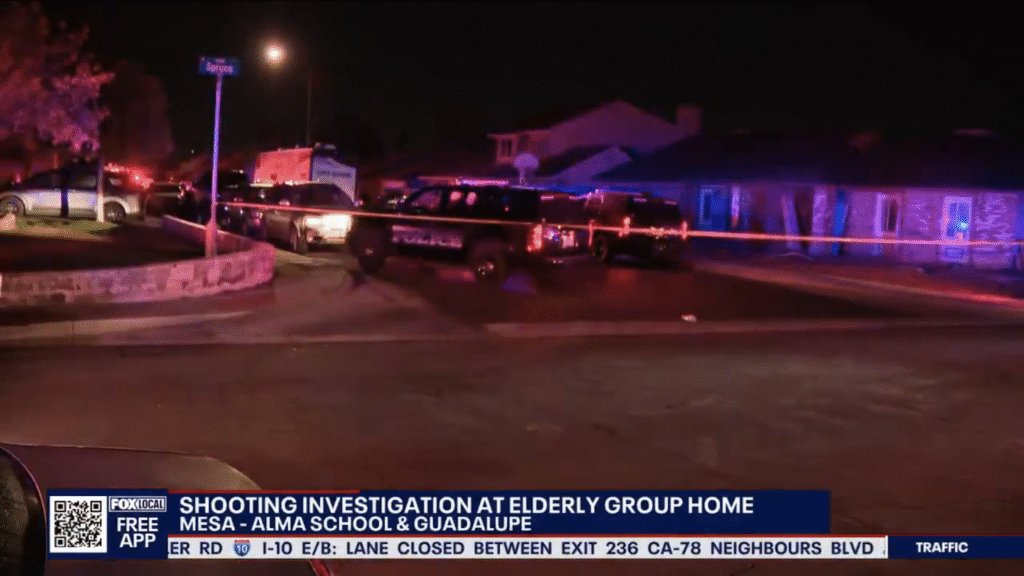
According to reports from local outlets and police statements, the Woolums couple had been residents of the assisted living home for some time. These are facilities designed for peace — quiet routines, soft schedules, and round-the-clock care. They are meant to be safe. Secure. A place where the final years of life are supposed to unfold gently. But for Jerome and Katharine, something inside that peace broke.
People who work with seniors say they’ve seen this before. They call it “caregiver despair.” When one spouse becomes sick, and the other — even if frail themselves — feels helpless. Sometimes it’s dementia. Sometimes it’s pain. Sometimes it’s the unbearable loneliness of watching the person you love disappear day by day, until mercy starts to look like escape.
It’s the kind of story that tears the internet in half.
When the news hit social media, reactions were instant — and divided. Some called Jerome a murderer. Others called him heartbroken. “We’ll never understand what he was feeling,” one commenter wrote on Facebook. “Maybe he just couldn’t watch her suffer anymore.” Another fired back: “There’s no excuse. Taking someone else’s life is never mercy.”
Even among experts, the debate is painful. Elderly murder-suicides, while rare, have been rising quietly in America’s aging population. According to studies, they often stem from desperation — the fear of illness, the burden of care, the feeling that death together is better than dying apart. But that explanation doesn’t make it easier to accept.
And it doesn’t explain how a 92-year-old man in a monitored care home had access to a gun in the first place.
That question has turned this quiet Arizona tragedy into a national conversation. How did a firearm get inside a senior living facility? Who knew it was there? How much freedom do residents really have in these places — and where should the line be between independence and safety?
Those are questions police and the facility’s management now face. The home, which hasn’t been named publicly, is a private “group care” residence — meaning it houses only a handful of seniors at a time, not a massive complex. Staff are on duty, but not security. There are usually no metal detectors, no bag checks, no locked drawers unless requested by families. For many of these homes, privacy is the selling point.

But in this case, privacy meant tragedy.
It’s hard not to imagine the scene — the gentle quiet of a Mesa morning, the desert light creeping through blinds, and two elderly figures lying side by side, the air still heavy with the echo of violence. Two lives that began in a different century, now ending in an act no one saw coming.
The police report reads sterile, clinical: two deceased, possible murder-suicide, investigation ongoing. But between those dry lines lies a story that refuses to be simplified.
People close to the couple have described them as “private,” “deeply devoted,” and “inseparable.” They’d been married for decades. They had grown old together. And yet, in the end, one of them chose to take both lives.
We may never know what conversation — or silence — preceded it.
That’s the horror of it. When tragedies like this happen in the prime of life, there are always clues: text messages, arguments, history. But at ninety, the motives are more elusive. Was it a plan whispered in fear? A sudden decision in the dark? Or the confused impulse of a mind slipping away?
For the staff at the care home, the trauma is real. These are people who dedicate their days to compassion — to helping seniors eat, walk, remember, survive. And now they have to live with the reality that something irreversible happened under their watch. No matter what the investigation concludes, that kind of guilt lingers.
It’s also reignited a darker question in America’s debate over aging: what happens when the will to live disappears before the body does?
Experts say the elderly suicide rate is quietly, alarmingly high. And among older men — especially those over 85 — it’s the highest of any age group. Combine that with access to firearms and declining mental health, and tragedies like this one become more predictable than anyone wants to admit.
And yet, the Woolums story still feels different. It feels too intimate. Too human. It’s not a data point — it’s a love story that ended in horror.
There’s a cruel irony at play: the same generation that lived through wars, recessions, and loss — the generation that built America’s middle class — is now facing its final battles in silence. And in facilities meant to protect them, no one seems prepared for the psychological storms that old age brings.
No one wants to talk about it — but this is the undercurrent of modern elder care. Behind the soft lighting and tidy rooms, behind the words “assisted living,” lies a population quietly breaking under the weight of time. They’re not just patients; they’re people watching their world shrink one hospital visit at a time.
And when you put two people in that space — two who have spent a lifetime together — their love can turn from comfort to co-dependence, and from co-dependence to despair.
That’s what some experts fear happened here. That Jerome, whether through illness or grief, made what he thought was an act of mercy — and in doing so, took everything from both of them.
The official police statement was brief. Mesa Police spokesperson Sgt. Charles Stump confirmed the couple’s names and their ages, noting only that the evidence pointed to a murder-suicide and that “the investigation remains active.” But beyond the formality of press releases, there’s the question no one can shake: could it have been prevented?
Because behind every “apparent murder-suicide,” there’s always a hidden chain of could-haves. Could someone have noticed his mental state changing? Could the home have had stricter firearm policies? Could the family have intervened if they knew what he was feeling?
The problem is, when people reach their nineties, everyone assumes the danger has passed. That violence belongs to the young, that despair burns out before the hair turns white. But this case proves the opposite: that pain doesn’t age, and neither does hopelessness.
In death, Jerome and Katharine’s story has become a mirror — reflecting a society deeply uncomfortable with the realities of aging. We celebrate longevity but rarely talk about what it feels like to live past the point where life still feels like living.
There’s a heartbreaking symmetry to the details. Ninety-two and ninety-three. Married for a lifetime. Living under the same roof until the end. Two gunshots in the dark. A love story that ended not with a goodbye, but with a decision no one will ever understand.
As the investigation continues, police have asked anyone struggling with suicidal thoughts — or worried about a loved one — to contact the 988 Suicide & Crisis Lifeline. But that message feels too small for what this story really represents.
Because what happened in that Arizona bedroom isn’t just about two people. It’s about how the system, and the culture around it, keeps missing the warning signs when it comes to the elderly — when despair hides behind politeness, when depression looks like forgetfulness, when someone says “I’m fine” and everyone believes them because they’re old.
This tragedy is a quiet explosion — not the kind that makes national headlines for long, but the kind that should. Because it’s a glimpse into the side of aging America that no one wants to look at: the loneliness, the helplessness, and the illusion that care facilities are enough to save people from themselves.
For now, all we know is that two lives — lives that once shared laughter, meals, holidays, and years — ended in a single moment that no one saw coming.
And maybe that’s what makes it so haunting.
Because when love lasts seventy years, you expect it to end in peace. You expect it to fade softly, one breath at a time, not in violence. You expect the story to close with a whisper, not a gunshot.
But somewhere in that room in Mesa, love turned into something darker. Something desperate. And it left behind a silence that’s impossible to explain.