At the 2008 Sundance Film Festival, an unexpected cultural intersection took place between Hollywood royalty and rock-music legend. Robert Redford, the festival’s founder, welcomed U2 to Park City, Utah, as the band premiered their groundbreaking 3D concert film U2 3D. The appearance transformed Sundance into a rare meeting point of cinema, activism, and global music influence, marking one of the festival’s most memorable moments of the decade.
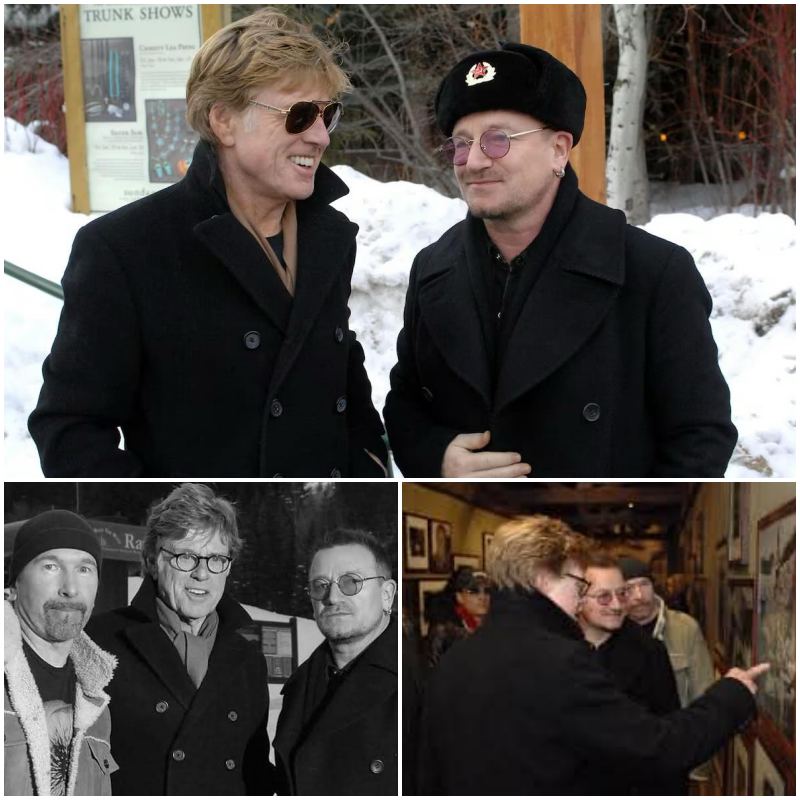
During the event, Bono and The Edge delivered an intimate early rendition of what would later become “No Line on the Horizon,” offering festival attendees a unique glimpse into a song still in formation. The performance, raw and unpolished, showed the creative chemistry that had always defined U2. Redford, known for his appreciation of artistic authenticity, was visibly moved by the spontaneous musical moment unfolding before him.
The Sundance Resort gathering on January 19, 2008, stood apart from typical promotional events. It emphasized genuine artistic exchange rather than scripted appearances. Redford and Bono shared the stage not merely as celebrity figures but as long-time advocates for social and environmental causes, turning the performance into an intersection of passion, purpose, and cultural expression.
U2 had been invited to Sundance to celebrate the premiere of U2 3D, a technologically ambitious film that captured their global tour with unprecedented visual depth. The movie, shot using advanced stereoscopic techniques, pushed boundaries in live-concert filmmaking. Its screening at Sundance symbolized the festival’s long-standing commitment to innovation, experimentation, and alternative approaches to storytelling.
For Bono, Sundance offered more than a promotional platform. It represented a community aligned with his artistic and humanitarian vision. The informal performance of the early “No Line on the Horizon” fit perfectly into the festival’s ethos of creative risk-taking. Audiences noted how the stripped-down version carried emotional weight distinct from the final studio release that would arrive a year later.
Redford’s presence alongside U2 highlighted the festival’s ability to attract figures who transcend their industries. Known for his cinematic legacy and dedication to independent filmmaking, he embraced the opportunity to connect with musicians who share a similarly expansive worldview. His rapport with Bono demonstrated the festival’s unique capacity to foster unexpected and meaningful collaborations.
The 2008 encounter also underscored the shifting identity of Sundance. No longer merely a showcase for films, it had evolved into a broader cultural platform. The fusion of cinema, music, activism, and technology represented Sundance’s direction in the late 2000s—a multidisciplinary hub where creative boundaries were meant to be challenged, reimagined, and expanded.
Music journalists covering the event described the moment as “a convergence of two icons of American and global culture.” Their reports reflected enthusiasm for seeing Redford and Bono engage in a genuine artistic dialogue. Links to early reviews of U2 3D highlighted the film’s reception, with critics praising its immersive qualities and its potential to reshape the future of concert documentaries.
The festival setting itself added to the atmosphere. Park City’s crisp January air, the rustic beauty of the Sundance Resort, and the characteristic informality of the event created a setting where artists felt comfortable experimenting. Photos from the gathering—widely circulated on entertainment news sites such as Rolling Stone and Variety—captured candid moments of laughter, quiet conversation, and shared admiration.
When “No Line on the Horizon” was officially released in 2009, fans reflected on the early Sundance performance with renewed appreciation. The polished studio track carried traces of the emotional tone that had first emerged in that intimate 2008 setting. Links to album retrospectives, including those from NME and Pitchfork, noted the song’s evolution from acoustic sketch to global release.
Today, the Redford–Bono moment remains a beloved footnote in Sundance history. It represents the festival’s spirit—where creativity flows freely, collaborations arise organically, and the lines between different art forms blur. The 2008 event endures not only in archived interviews and entertainment-news links but also in the memories of those who witnessed a rare intersection of cinematic vision and musical innovation.